


12-11-2024, 12:48 PM
Hello All.
It's been a few weeks since the last update, but there is quite a bit to report.
I've taken the last [almost] month to work solidly on getting the new machines a lot closer to production.
The first couple of weeks were solely dedicated to working through the [FPGA] logic design and ensuring it was stable.
I tracked down quite a number of potential timing issues (data not meeting setup times to clock edges) and solved a few
intermittent problems as a result. I reported last that the SDcard was intermittent, and I thought I had fixed that, but depending on
the build / compile of the FPGA logic, that was still faulty. I found the cause, and it related to another few parts as well, including
an intermittent issue in reading from the configuration flash rom (in which the Z80 mode Boot Rom image is stored). This is now
solidly fixed and tested.
Next I tackled some timing issues still persisting in the video display area, and also the 'Videotex' video mode (where the pixel clock
is half the normal rate) which allows for 32 / 40 column mode. All this is now working really well.
The next major area to get on with was the HDMI output. I needed to verify this functionality before doing [what will hopefully be] the
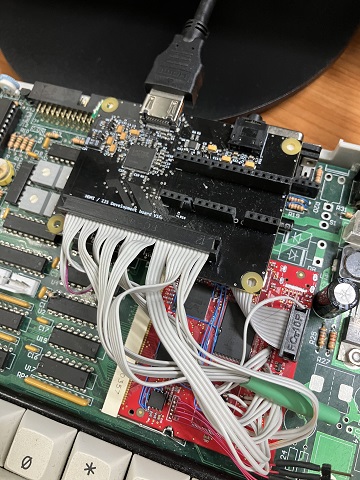
production PCBs. You may recall that I'd designed an HDMI dev board to test this out from an earlier post in this thread.
To start with, and before I attached the HDMI dev board, I needed to get the I2C bus working on the 68SZ328 processor.
This bus is used for a number of peripherals, including [obviously] the HDMI transmitter and the new Real Time Clock.
After implementing some code, I was able to access the RTC straight away and confirm chip ID and that the Unix Time counters
were running. I2C bus - Tick.
To get the HDMI transmitter going, I needed to attach it to the FPGA board video output section and then program up some
configuration of the part on the board via the I2C bus. Straight away I could read the chip ID to verify the I2C bus connection
and then configure the part and turn the transmitter on. While there is still some programming to do to read the display information
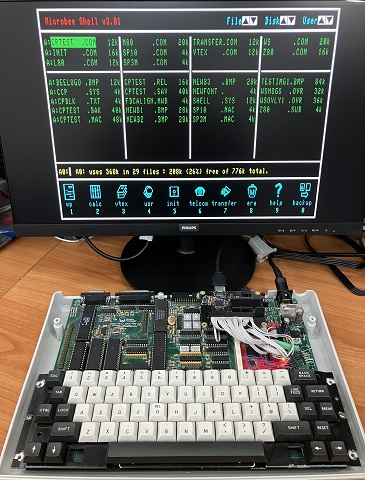
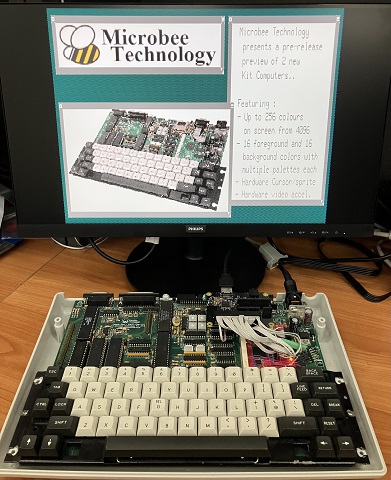
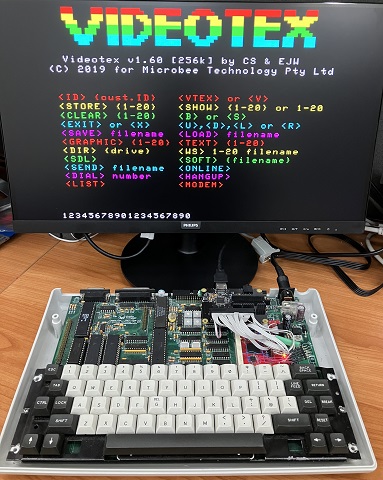
out of the monitor (EDID) and properly configure the video descriptors, the HDMI output now works and is crystal clear.
See the photos below.
I was hoping to test out the I2S sound that is included on the HDMI Dev board as well, but there are not enough accessible free FPGA
pins on the current FPGA board to connect the I2S sound signals (or the HDMI interrupt signal for that matter, which services
Hot Plug events), so that will need to be tested when the new PCBs are done.
Aside from the development work, I've started ordering the critical components.
I already have the metalwork for the 64 key keyboard frame - I had this done long ago.
I've ordered 120 sets of the 64 key layout key caps, and they should arrive just before Christmas.
I'm working with a new supplier for the 98 key keyboard key cap sets and should have 100 sets of
those pre-christmas as well.
So, as you can see, the project has moved forward significantly in the last month.
Here's the photos :
It's been a few weeks since the last update, but there is quite a bit to report.
I've taken the last [almost] month to work solidly on getting the new machines a lot closer to production.
The first couple of weeks were solely dedicated to working through the [FPGA] logic design and ensuring it was stable.
I tracked down quite a number of potential timing issues (data not meeting setup times to clock edges) and solved a few
intermittent problems as a result. I reported last that the SDcard was intermittent, and I thought I had fixed that, but depending on
the build / compile of the FPGA logic, that was still faulty. I found the cause, and it related to another few parts as well, including
an intermittent issue in reading from the configuration flash rom (in which the Z80 mode Boot Rom image is stored). This is now
solidly fixed and tested.
Next I tackled some timing issues still persisting in the video display area, and also the 'Videotex' video mode (where the pixel clock
is half the normal rate) which allows for 32 / 40 column mode. All this is now working really well.
The next major area to get on with was the HDMI output. I needed to verify this functionality before doing [what will hopefully be] the
production PCBs. You may recall that I'd designed an HDMI dev board to test this out from an earlier post in this thread.
To start with, and before I attached the HDMI dev board, I needed to get the I2C bus working on the 68SZ328 processor.
This bus is used for a number of peripherals, including [obviously] the HDMI transmitter and the new Real Time Clock.
After implementing some code, I was able to access the RTC straight away and confirm chip ID and that the Unix Time counters
were running. I2C bus - Tick.
To get the HDMI transmitter going, I needed to attach it to the FPGA board video output section and then program up some
configuration of the part on the board via the I2C bus. Straight away I could read the chip ID to verify the I2C bus connection
and then configure the part and turn the transmitter on. While there is still some programming to do to read the display information
out of the monitor (EDID) and properly configure the video descriptors, the HDMI output now works and is crystal clear.
See the photos below.
I was hoping to test out the I2S sound that is included on the HDMI Dev board as well, but there are not enough accessible free FPGA
pins on the current FPGA board to connect the I2S sound signals (or the HDMI interrupt signal for that matter, which services
Hot Plug events), so that will need to be tested when the new PCBs are done.
Aside from the development work, I've started ordering the critical components.
I already have the metalwork for the 64 key keyboard frame - I had this done long ago.
I've ordered 120 sets of the 64 key layout key caps, and they should arrive just before Christmas.
I'm working with a new supplier for the 98 key keyboard key cap sets and should have 100 sets of
those pre-christmas as well.
So, as you can see, the project has moved forward significantly in the last month.
Here's the photos :